
The Short Answer: What You Need to Know First
Knowing how to design a built in wardrobe comes down to four essentials: accurate measurements, a clear understanding of your storage needs, the right internal layout, and finishes that suit your home’s style. Get these four things right and you’ll end up with a wardrobe that works beautifully for years to come.
Whether you’re fitting out a new build in Melbourne’s northern suburbs or renovating a Federation-era home in the inner east, the design process follows the same logical steps. Let’s walk through each one.
Step 1 — Measure Your Space Accurately
Before you sketch a single design idea, grab a tape measure. You need the exact width, height, and depth of the alcove or wall space you’re working with. In many Melbourne homes — particularly older brick veneer properties — walls are rarely perfectly square, so measure at multiple points.
Standard built-in wardrobe depth sits between 550mm and 600mm, which comfortably accommodates hanging garments without sleeves brushing the doors. If your space is shallower, you may need to consider folded storage or angled hanging rails instead. Write everything down and double-check before you move forward.
Step 2 — Audit Your Wardrobe Contents
This step is where most homeowners skip ahead too quickly. Before you can design the right internal configuration, you need to know exactly what you’re storing. Pull everything out of your current wardrobe and sort it into categories.
Think about how much of each type of storage you actually need:
- Long hanging space for dresses, coats, and suits
- Short hanging space (half-height) for shirts, jackets, and folded trousers
- Shelf space for folded knitwear, jeans, and casual wear
- Drawers for underwear, socks, and accessories
- Shoe storage — shelves, racks, or pull-out trays
- Overhead shelf for luggage, seasonal items, and bulky bedding
Melbourne’s four-season climate means most households store both warm-weather and cold-weather wardrobes simultaneously. Factor in space for your winter coats and heavy blankets, not just your summer wardrobe.
Step 3 — Choose Your Internal Layout
Once you know what you’re storing, you can plan the internal configuration. A well-designed layout divides the wardrobe into zones that reflect how you actually get dressed each morning.
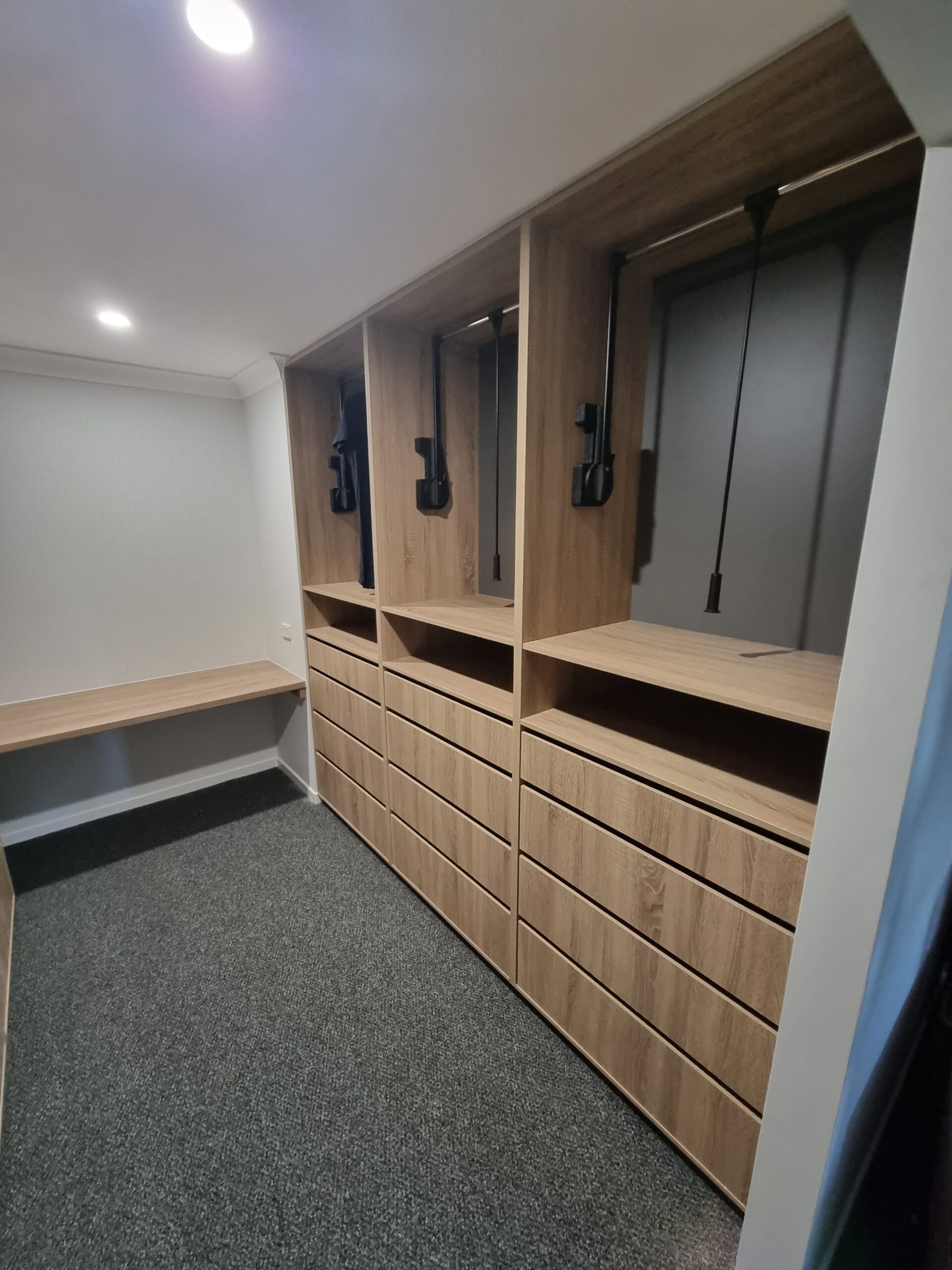
A popular layout for a standard 1800mm–2400mm wide wardrobe combines a full-height hanging section on one side, a double-hang section in the centre, and a tower of shelves or drawers on the other side. This gives you flexibility without wasting a single millimetre of space. If you’re working with a larger alcove, consider adding a dedicated shoe tower or a pull-out laundry hamper — both are practical additions that make everyday life easier.
For shared wardrobes, divide the space clearly down the middle so each person has their own zone. It sounds simple, but it eliminates a surprising amount of daily frustration.
How to Design a Built In Wardrobe: Doors and Access
The door style you choose affects both the look of your bedroom and the practicality of your wardrobe. The three main options are sliding doors, hinged doors, and open (doorless) robes.
Sliding doors are the most popular choice in Melbourne bedrooms because they don’t require clearance space to swing open — ideal for smaller rooms. Hinged doors give you full, unobstructed access to the entire interior at once, which some people strongly prefer. Open robes work beautifully in larger bedrooms or walk-in configurations but require you to keep the interior tidy at all times.
If you’re planning built in wardrobes in Craigieburn or similar growth-area homes with generous room sizes, hinged doors often work well. In tighter inner-suburb bedrooms, sliding doors are almost always the smarter choice.
Step 4 — Select Materials and Finishes
The material and finish you choose determines how your wardrobe looks, how durable it is, and how easy it is to keep clean. Most built-in wardrobes in Australian homes use moisture-resistant MDF or particleboard carcasses with a melamine or polyurethane finish.
Melamine is cost-effective, durable, and available in a wide range of colours and woodgrain textures. Polyurethane delivers a smooth, high-gloss or matte finish that looks premium and wipes down easily. If your bedroom has a contemporary feel, a two-tone design — say, white carcass with a charcoal or timber-look door — adds visual depth without overwhelming the space.
For hardware, soft-close hinges and drawer runners are worth every cent. They make the wardrobe feel high quality every single time you use it, and they protect the cabinetry from the wear and tear of daily use. You can explore a range of custom finish options through the team at Perfect Kitchen & Robes.
Step 5 — Plan Your Lighting
Wardrobe lighting is often an afterthought, but it makes a genuine difference to how usable your robe is. A dark wardrobe makes it harder to match colours and find items quickly, especially during Melbourne’s shorter winter mornings.
LED strip lighting along the underside of shelves is an affordable and effective option. Motion-activated LED downlights inside the wardrobe are another popular choice. If you’re planning a walk-in configuration, consider a central ceiling light on a separate switch. Good lighting also makes the interior feel larger and more considered.
When to Call a Professional
DIY flat-pack wardrobes work for straightforward, standard-sized spaces. But if your room has angled ceilings, awkward alcoves, uneven walls, or you simply want a result that looks truly custom and built to last, it’s worth calling in an experienced cabinet maker.
A professional will handle precise scribing to your walls, recommend the right internal configuration for your specific needs, and manage the entire build from measure to install. If you’re in Melbourne’s northern suburbs, the team at Perfect Kitchen & Robes specialises in custom built-in wardrobes designed around your space and lifestyle. Get in touch for a no-obligation measure and quote.
Conclusion
Learning how to design a built in wardrobe is about working through a clear process: measure accurately, audit your storage needs, plan your internal layout, choose the right doors and finishes, and don’t forget the lighting. Each decision builds on the last, and getting the early steps right makes every choice after that much easier.
A well-designed built-in wardrobe adds genuine storage value, improves your daily routine, and increases the appeal of your home — whether you’re staying long-term or planning to sell. If you’d like expert help bringing your design to life, reach out to the team at Perfect Kitchen & Robes for professional advice and a custom solution tailored to your Melbourne home.
Frequently Asked Questions
What is the standard depth for a built in wardrobe in Australia?
The standard depth for a built-in wardrobe in Australia is between 550mm and 600mm. This depth allows hanging garments to sit comfortably without the sleeves touching the doors. If your space is shallower, you may need to adapt the internal layout to prioritise shelving and folded storage over hanging rails.
How much does a custom built in wardrobe cost in Melbourne?
The cost of a custom built-in wardrobe in Melbourne varies depending on size, materials, internal fittings, and door style. As a general guide, a basic single-bedroom wardrobe might start from around $1,500–$2,500, while larger or more complex designs with premium finishes can range from $3,000 upwards. Getting a measure and quote from a local cabinet maker is the best way to get an accurate figure for your specific space.
Do I need council approval to install a built in wardrobe in Melbourne?
In most cases, installing a built-in wardrobe inside an existing bedroom does not require council planning approval in Victoria, as it is considered internal fit-out work. However, if your renovation involves structural changes to walls or is part of a larger building project, it’s worth checking with your local council or referring to the Victorian Building Authority at vba.vic.gov.au to confirm what permits may apply.
What is the best internal layout for a shared built in wardrobe?
For a shared wardrobe, the most practical approach is to divide the space into two clearly defined zones — one for each person. Each zone should include a mix of hanging space and shelf or drawer storage tailored to that person’s wardrobe. A central tower of drawers can also serve as a natural divider while adding useful storage for both users. For more about what we do, visit our homepage.