
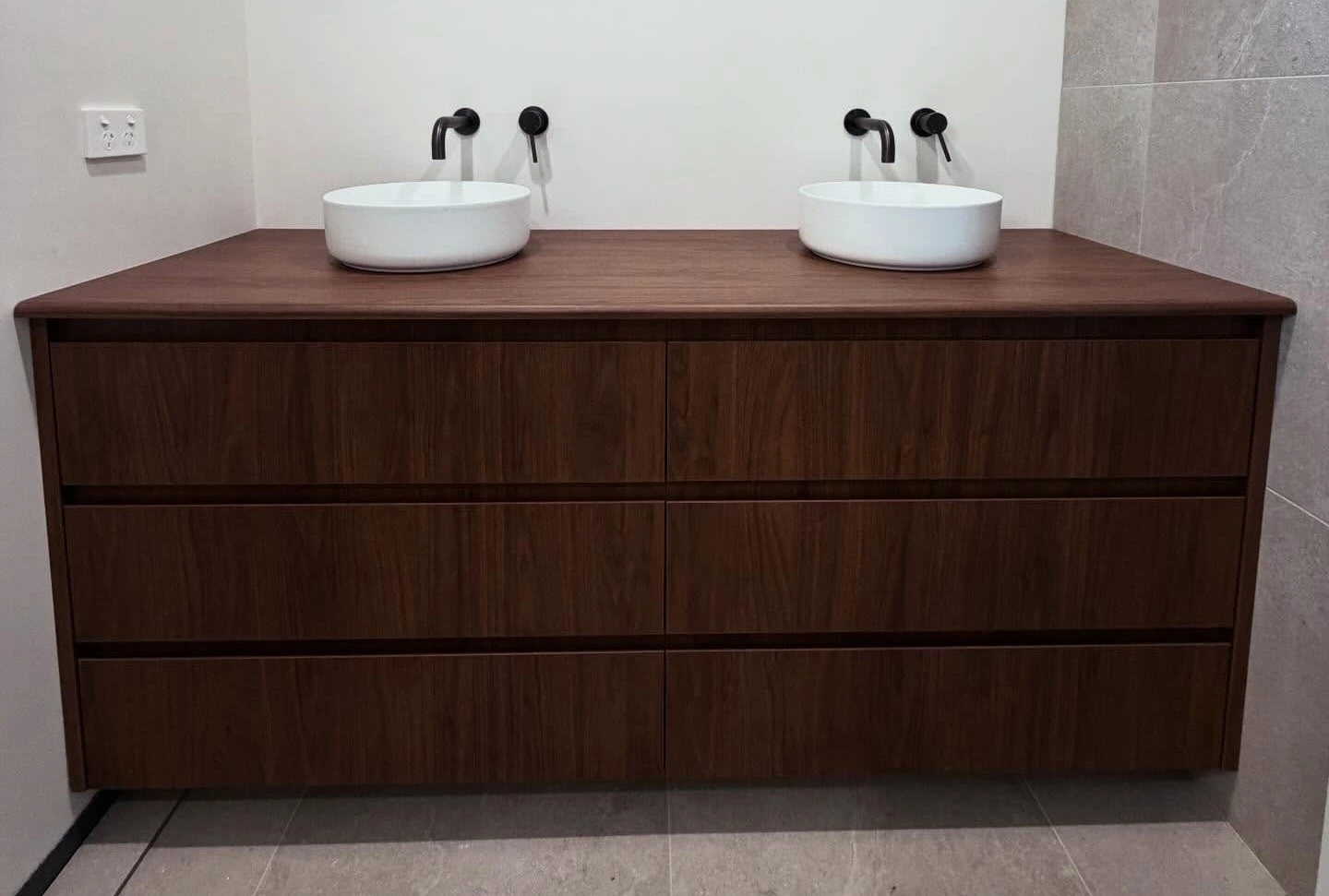
For most Melbourne bathrooms, bathroom vanity cabinet materials such as moisture-resistant board with fully sealed edges, or water-resistant plywood, hold up far better than standard board. Solid timber and PVC can also work, but each comes with trade-offs worth understanding before you commit.
Melbourne isn’t a tropical city, but a hot shower can turn a small bathroom into a steam room. That trapped moisture is what swells and peels cheap cabinets, not the weather outside. A well-planned custom bathroom vanity starts with choosing a material that suits how your bathroom is actually used. This guide compares the main options, explains what makes a vanity last and helps you match the material to your space.
Which Bathroom Vanity Cabinet Materials Handle Humidity Best?
Here’s the quick version before we get into detail:
| Material | Humidity performance | Best for |
| Moisture-resistant MDF (2-pack painted) | Good if edges and cut-outs are sealed | Smooth painted finishes, modern designs |
| Moisture-resistant particleboard (melamine) | Good with proper edge sealing | Budget-friendly, practical builds |
| Water-resistant or marine plywood | Very good | Long-lasting vanities, heavy use |
| Solid timber | Fair to good if well sealed | Warm, natural look, with upkeep |
| PVC or polymer | Excellent | Very wet or poorly ventilated rooms |
If you want a single recommendation, a vanity built from moisture-resistant board or plywood, finished properly and sealed on every cut edge, suits most homes. The rest of this guide explains why.
Why Humidity Is So Hard on Vanities
A bathroom vanity sits in the worst spot in the house for moisture. It’s close to a shower, a basin and a bath, and it often lives in a room with limited airflow.
Most bathroom vanity cabinet materials are made from wood fibre or chips bonded with resin. These boards hold up well until water reaches the raw core. Once moisture gets in, the board swells, the surface lifts, and the damage can’t be reversed. The weak points are almost always the same: cut edges, sink and tap holes, the base of the cabinet and the back panel near plumbing.
Melbourne’s climate adds its own twist. According to the Bureau of Meteorology’s climate statistics for Melbourne, humidity here sits in a moderate range and tends to be higher in the morning and through winter. That matters because winter is when we close windows, run hot showers and trap steam. Older homes with weak exhaust fans feel it most. So when we talk about moisture-resistant bathroom cabinets, we’re really talking about handling steam, splashes and slow condensation, not just a wet climate.
Bathroom Vanity Cabinet Materials Compared
Moisture-Resistant MDF
MDF is a smooth, dense board that takes paint beautifully, which is why it’s popular for 2-pack painted doors and drawer fronts. Moisture-resistant grades are made to cope better with damp conditions than standard MDF.
The catch: it still isn’t waterproof. Once water gets past the paint into the core, it swells. A moisture-resistant vanity made from MDF only works if every face, edge and cut-out is sealed properly. It’s a strong choice for a painted, modern look, but not the one to pick if the bathroom is poorly ventilated and you’re not planning to fix that.
Moisture-Resistant Particleboard (Melamine)
Melamine-faced particleboard is a common, cost-effective choice for cabinet carcasses. The melamine surface resists splashes and wipes clean easily.
Its weakness is the edge. Where the board is cut, the exposed core can soak up water. Good edging, applied tightly with no gaps, is what separates a vanity that lasts from one that bubbles at the base after a couple of years. For a budget-conscious renovation, this is often the practical option, as long as the build quality is solid.
Plywood
Plywood is made from layers of thin timber veneer glued together. Water-resistant and marine-grade plywood uses glues designed to cope with moisture, and plywood generally tolerates the odd leak or splash better than board made from fibre or chips.
It’s heavier and often costs more than board, but it holds screws and hinges well, which helps in drawers that get daily use. The exposed edges still need sealing, and a plywood edge can look striking if it’s finished as a design feature.
Solid Timber
Solid timber looks and feels warm, and it suits traditional and organic designs. The challenge is that timber moves. It absorbs and releases moisture with changes in humidity, which can lead to gaps, warping or cracking if it isn’t finished well.
A solid timber vanity can work in a bathroom, but it needs a quality sealed finish and a little ongoing care. If you love the look but worry about humidity, many people use timber veneer over a stable core instead.
PVC and Polymer Cabinets
PVC and polymer cabinets don’t absorb water, so they’re the toughest option for very wet or poorly ventilated rooms. They won’t swell or rot.
The trade-off is design. The range of finishes and the custom flexibility are usually narrower than with board, and they can feel less premium. They suit laundries and utility bathrooms well. For a main bathroom where style matters, many homeowners prefer sealed board or plywood.
What Matters as Much as the Material
Here’s something most guides skip: the material is only half the story. Two vanities made from the same bathroom vanity cabinet materials can age very differently depending on how they’re built and finished.
Edge sealing: This is the biggest factor. Look for tight, full-length edging on every exposed edge, including the back and underside.
Finish quality: A durable 2-pack paint, quality laminate or a well-applied sealed finish protects the surface. Cheap vinyl wraps can peel when heat and steam work under the edges.
Cut-outs: Sink, tap, and plumbing holes should be sealed. Water from a small drip follows the path of least resistance straight into raw board.
Hardware: Rust-prone hinges and runners fail first in a humid room. Corrosion-resistant hardware is worth the small extra cost.
Ventilation: An exhaust fan that vents outside, used during and after showers, protects every material on this list. It’s the cheapest way to extend the life of your cabinetry.
Benchtop and basin seal: Silicone around the basin and tap area keeps splashes out of the cabinet below. Reseal it when it starts to crack.
Matching Bathroom Vanity Cabinet Materials to Bathroom
The right choice depends on your room, not just the material list.
- Main bathroom with a shower and good ventilation: moisture-resistant board with sealed edges and a quality painted or laminate finish is usually plenty.
- Ensuite with limited airflow: consider plywood or add a better exhaust fan. Steam lingers longer in small, enclosed rooms.
- Powder room: almost any sealed option works, as moisture exposure is low. Design can lead the decision.
- Family bathroom with kids and heavy use: plywood or a tougher, easy-clean finish handles splashes and daily wear better.
- Older home with poor ventilation: consider upgrading the fan first, then choose the more water-tolerant materials.
Material choice also shapes price. Plywood and speciality finishes cost more than melamine board, and custom sizing adds to the total. Setting a realistic bathroom vanity budget before you pick a material helps you balance durability against cost.
Common Mistakes to Avoid
- Choosing standard board because it looks the same. Standard and moisture-resistant boards can look identical on the surface, and the difference only shows after a few years of steam.
- Ignoring the edges. A moisture-resistant core is wasted if the edges are left open.
- Skipping ventilation. Even the best bathroom vanity cabinet materials struggle in a room that never dries out.
- Picking on price alone. A cheaper vanity that needs replacing in five years rarely saves money.
- Forgetting maintenance. Wipe up standing water, keep silicone intact and check under the basin once in a while.
Conclusion
Humidity is the biggest test any vanity faces, and the right bathroom vanity cabinet materials make the difference between a cabinet that lasts and one that swells within a few years. Moisture-resistant board and water-resistant plywood suit most Melbourne bathrooms, solid timber needs a little extra care and PVC is the toughest option for very wet rooms. Whatever you choose, sealed edges, quality hardware and a working exhaust fan do as much for longevity as the material itself.
Ready to plan a vanity that stands up to daily steam? Contact Perfect Kitchen & Robes today for a free quote and get expert advice on the best material, finish and design for your Melbourne bathroom.
Frequently Asked Questions
-
1. What are the best bathroom vanity cabinet materials for humid bathrooms?
Water-resistant plywood and well-sealed moisture-resistant board are the most reliable choices for most homes. PVC and polymer perform best in very wet rooms. Whichever you choose, sealed edges and good ventilation matter as much as the material itself.
-
2. Is MDF OK for a bathroom vanity?
Moisture-resistant MDF can work well, especially with a sealed 2-pack painted finish. Standard MDF isn't a good fit, because it swells quickly once water reaches the core. Always ask how the edges and cut-outs are sealed.
-
3. Is plywood better than particleboard for a bathroom vanity?
Generally, yes, when it comes to moisture tolerance and screw-holding strength. Plywood usually costs more, so particleboard with excellent edging is still a sensible option for a tighter budget.