
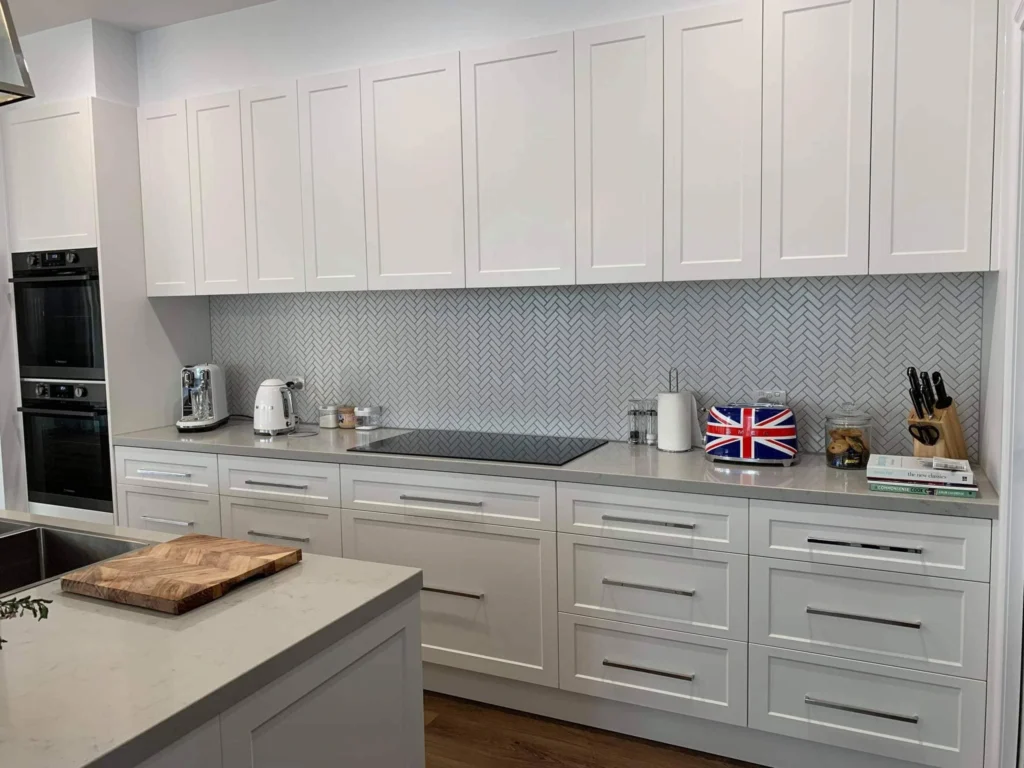
The best kitchen cabinet door style is the one that suits your home’s architecture, copes with the way you actually cook, and fits your budget. For most Melbourne homes, that means choosing between shaker kitchen doors, flat panel doors and a more traditional profile. Because doors cover most of the visible surface, this one choice shapes the whole room.
This guide explains each option, what it asks of you in upkeep, and how to match it to your home. If you’re planning custom kitchens in Melbourne, it will help you walk into your design consultation knowing which door styles to ask about.
Which Kitchen Cabinet Door Style Is Right for You? The Quick Answer
If you want the short version, start here:
- Shaker kitchen doors: best for period homes, Hamptons kitchens and anyone who wants a classic look that doesn’t feel dated.
- Flat panel doors: best for modern, minimalist and handleless kitchens, and the easiest style to wipe clean.
- Raised panel doors: best for Victorian, Edwardian and provincial homes where you want real character.
- Glass-front, VJ and fluted doors: best as accents on a few cabinets, not the whole kitchen.
Still torn between two kitchen cabinet door styles? Ask your cabinet maker for samples of both in the finish you like, and look at them in your own kitchen. A door sample on a showroom shelf tells you very little about how it will look next to your floors and window light.
Kitchen Cabinet Door Styles Explained
Shaker Kitchen Doors
A shaker door has a square frame around a flat, slightly recessed centre panel. There’s no ornate detailing, which is why it fits so many looks. Paint it white or soft grey for a Hamptons feel, or go deep green or charcoal for something more current.
Pros: versatile, timeless and forgiving in both older and newer homes.
Cons: the recessed edges can hold dust and grease, so the corners need a wipe-down more often. Shaker doors also need more machining than a slab door, so they usually cost more.
Best for: family kitchens, period homes, and open-plan layouts where the kitchen is on show.
Flat Panel Doors
Flat panel doors, also called slab doors, are a single flat piece with no frame and no profile. They’re the go-to for modern, contemporary and minimalist kitchen cabinet designs, and the finish does the talking: woodgrain laminate, matte 2-pack paint or gloss.
Pros: easy to clean, work well handleless, and usually cost less to make than framed doors.
Cons: glossy and dark matte finishes show fingerprints. A flat door also has nowhere to hide, so poor alignment or uneven gaps are obvious. That makes build quality matter more here than with any other style.
Best for: modern homes, townhouses, and anyone who wants the simplest cleaning routine.
Raised Panel and Traditional Kitchen Cabinet Doors
Traditional kitchen cabinet doors usually have a frame with a raised, profiled centre panel and sometimes detailed edges. They add depth and character, and they sit comfortably in Victorian, Edwardian and Federation homes or a provincial-style kitchen.
Pros: a rich, handcrafted look with a real sense of age.
Cons: the detailed profile is the hardest to clean, and it can look heavy in a small kitchen or a newer build. A good compromise is to use raised panels on an island or a dresser-style piece and keep the rest of the run simpler.
Glass-Front, VJ and Fluted Doors
These work best as accents. Glass-front doors suit display cabinets above the bench. VJ (V-groove) boards fit coastal and Hamptons kitchens. Fluted panels add texture to an island. Used on a few cabinets, they add interest. Used everywhere, they get busy fast.
Kitchen Cupboard Door Styles Compared
| Style | Look | Cleaning | Typical cost | Best for |
| Shaker | Classic, versatile | Moderate (recessed edges) | Mid | Period and family homes |
| Flat panel | Modern, minimal | Easiest | Lower | Contemporary and handleless kitchens |
| Raised panel | Traditional, detailed | Hardest | Higher | Victorian, Edwardian, provincial |
| Glass, VJ, fluted | Accent | Varies | Varies | Feature cabinets and islands |
Costs here are relative. Your final price depends on materials, finish, hardware and the size of the kitchen, so use the table to compare styles, not as a quote.
What Suits Common Melbourne Home Types
- Victorian and Edwardian terraces: shaker or raised panel doors echo the original detailing. A slab door can also work if you want a clear contrast with the period features.
- Californian bungalows and weatherboards: shaker doors in a soft colour sit comfortably with timber floors and exposed beams.
- Brick veneer family homes: shaker and flat panel both work, so let your finish and hardware decide the look.
- New builds, townhouses and apartments: flat panel doors suit clean lines and compact layouts, especially when the kitchen is part of an open-plan living space.
Materials and Finishes That Affect Your Kitchen Cabinet Door Style
Your kitchen cabinet door style is only half the picture. The material and finish change how it looks, how long it lasts and what it costs.
- Laminate and melamine: durable, affordable and available in a wide range of colours and woodgrains. Best suited to flat panel doors.
- 2-pack polyurethane: a smooth painted finish that suits shaker and profiled doors. You can choose a custom colour, but it usually costs more.
- Vinyl wrap: a film pressed over routed board, which lets it cover profiled doors in one piece. Ask your maker about heat exposure near ovens, since poorly applied wrap can lift.
- Timber veneer: natural grain and warmth, with a higher price and a bit more care needed.
When planning a kitchen renovation, consider more than just appearance and cost. Choosing durable, low-maintenance and environmentally sustainable materials can also make a difference to the long-term value of your home. The Australian Government’s YourHome website highlights these factors when selecting materials for home renovations.
How to Choose the Right Kitchen Cabinet Door Style
1. Start with your home, not a photo
Look at your skirting boards, window frames, cornices and floors. A home with original timber floors and decorative cornices usually welcomes shaker or raised panel doors. A new build often suits flat panel. You can mix old and new on purpose, such as slab doors in a Victorian terrace, but it works best as a deliberate choice rather than a default.
2. Think about how you cook
Do you fry or use a wok often? Do you have young kids with sticky hands? Grease and fingerprints collect differently on each kitchen cabinet door style. Flat panels wipe clean in seconds, while a shaker or raised panel needs a little attention around the edges.
3. Choose the finish together with the door
The same shaker door looks very different in matte 2-pack paint than in woodgrain laminate. Pick the finish at the same time as the door, and check samples in your own light. A south-facing Melbourne kitchen gets less direct sun, so colours can look cooler and darker than they did in the showroom.
4. Set your budget early
Your kitchen cabinet door style affects cost through labour and machining, and the finish adds to it. Cabinetry sets the style of a kitchen and also makes up most of the renovation cost. That’s a good reason to settle your door style before you lock in the rest of the budget.
5. Plan your handles and hardware
Your kitchen cabinet door style and hardware go together. Flat panels suit handleless finger-pull profiles, shaker doors look at home with simple bar or knob handles, and traditional doors often suit cup pulls or knobs. Soft-close hinges and drawers are worth including whatever style you pick, since you’ll feel the difference every day.
6. Think beyond the kitchen
If your pantry, laundry or butler’s pantry is visible from the kitchen, carry the same door style through. The same goes for your kitchen wardrobe design, meaning tall pantry units and appliance walls that work like wardrobes. Matching the door style stops the room from looking pieced together.
Kitchen Cabinet Door Replacement: When It Makes Sense
If your cabinet boxes are solid and the layout works, replacing the doors and drawer fronts can change your kitchen cabinet door style for less than a full kitchen cabinet renovation. Our guide on whether you can replace cabinet doors without replacing the cabinets covers it in more detail.
Kitchen cabinet door replacement works well when:
- The cabinet boxes are sound, with no swelling or water damage
- You’re happy with the layout and storage
- You want a new look, a new finish or soft-close hinges without starting from scratch
It isn’t the right answer if the layout frustrates you, the storage is poor, or the boxes are damaged. In those cases, a full renovation gives you a better result for the money.
Common Mistakes When Choosing a Kitchen Cabinet Door Style
- Choosing from photos only. Colours and finishes look different in person.
- Mixing too many styles. Stick to one main door style and one accent.
- Following a trend that dates quickly. A bold colour is easier to change later than a heavily profiled door.
- Ignoring maintenance. A style you dislike cleaning will frustrate you every week.
- Forgetting the rest of the room. Doors need to work with your benchtop, splashback and flooring.
Why Work With a Custom Cabinet Maker
Off-the-shelf doors come in set sizes and a limited range of styles. A custom cabinet maker builds doors to your exact measurements, so there are no awkward filler panels, and you choose the kitchen cabinet door style, finish and hardware yourself. Perfect Kitchen & Robes has over 25 years of experience designing and building kitchens across Melbourne, and we handle design, manufacturing and installation in one process. That means one team is accountable for how your doors fit and finish.
Conclusion
Choosing a kitchen cabinet door style comes down to three questions: does it suit your home, will it handle your daily routine, and does it fit your budget? Shaker doors are the safe, versatile pick. Flat panels are the modern, low-maintenance pick. Traditional doors bring character to period homes.
Not sure which style suits your home? Our Melbourne cabinet makers can walk you through door samples, finishes and layouts for your space. Request a free custom kitchen quote from Perfect Kitchen & Robes, and we’ll help you choose the right kitchen cabinet door style for your kitchen.
FAQs:
-
1. What is the difference between shaker and flat panel kitchen doors?
A shaker door has a framed, slightly recessed centre panel, while a flat panel door is one smooth slab. Shaker suits classic and transitional kitchens, and flat panel suits modern and minimalist ones. Flat panel is also easier to clean.
-
2. Are shaker kitchen doors still in style?
Yes. Their simple lines work across traditional, Hamptons and contemporary kitchens, which is why they’ve stayed popular. You can update the look with colour and hardware without changing the door.
-
3. Which kitchen cabinet door style is easiest to clean?
Flat panel doors, because there are no grooves or recesses to collect grease and dust. A wipe with a damp cloth is usually enough.
-
4. Does kitchen cabinet door style change the cost of a kitchen?
Yes. Framed and profiled doors usually cost more than flat panels because they need more machining and labour. Finish, hardware and kitchen size also affect the price, so a quote based on your design is the only reliable figure.